library(bixverse)
library(bixverse.plots)
library(data.table)
#>
#> Attaching package: 'data.table'
#> The following object is masked from 'package:base':
#>
#>     %notin%
library(ggplot2)
library(magrittr)
Batch correction with bixverse
2026-09-24
Intro
Batch effects are systematic technical differences between experimental runs that can obscure genuine biological signal in single cell data. When datasets from multiple experiments, technologies, or laboratories are combined, cells tend to group by their source rather than by cell type. Batch correction methods aim to remove these technical artefacts whilst preserving biological variation.
bixverse provides four batch correction approaches, each with different trade-offs:
fastMNN (Haghverdi, et al., 2018) identifies mutual nearest neighbours across batches – pairs of cells from different batches that are each other’s closest match. Correction vectors are computed from these pairs and applied to align the embeddings. It is particularly effective when cell type composition differs across batches.
Harmony (Korsunsky, et al., 2019) operates on PCA embeddings using iterative soft clustering with diversity penalties. It assigns cells to clusters, estimates batch effects per cluster via ridge regression, and corrects the embedding. It tends to be fast and works well across a range of scenarios. Additionally, a version 2 has been released, see Patikas, et al., 2026 with improvements that increase scalability to larger data sets and modifications to the objective functions to not overcorrect across batches when different cell types are there.
BBKNN (Polanski, et al., 2020) takes a fundamentally different approach. Rather than correcting an embedding, it constructs a batch-balanced k-nearest neighbour graph by building separate neighbour indices per batch. The corrected graph can then be used directly for clustering and visualisation.
Seurat anchors (Stuart, et al., 2019) find pairs of cells that are mutual nearest neighbours in a space shared by two batches, score them by how much of their neighbourhood they share, and use them to pull one batch onto the other. Two flavours are available. CCA builds the shared space from canonical correlations and corrects hardest, which suits batches that don’t share their cell types. rPCA projects each batch into the other’s PCA basis instead: cheaper, gentler, and the better default when the batches broadly match. Both need batch-aware HVGs.
A correction has two jobs: mix the batches and keep the biology intact. Going too hard on the first ruins the second, so bixverse scores both, following the scIB benchmark (Luecken, et al., 2022).
Batch mixing:
- kBET: tests whether neighbourhood batch proportions match the global ones.
- Batch ASW: silhouette width on batch labels in the embedding.
- iLISI: effective number of batches per neighbourhood. Works on any kNN graph.
- PCR: how much of the embedding variance batch explains, before versus after correction.
Bio conservation, which needs cell type labels:
- cLISI: effective number of cell types per neighbourhood. You want one.
- Cell type ASW: silhouette width on cell type labels.
- Graph connectivity: whether each cell type stays one connected piece of the kNN graph.
calculate_integration_metrics_sc() runs the lot and returns one row, every column rescaled so that higher is better.
Preparing the data
Loading the batches
We use two PBMC datasets (pbmc3k and pbmc4k) as a standard benchmark for batch correction. These come from the same tissue but differ in sequencing depth and cell counts, introducing a clear batch effect.
Code
dir_data <- download_pbmc_batches()

tempdir_batch_cor <- file.path(tempdir(), "batch_cor_bixverse")
dir.create(tempdir_batch_cor, showWarnings = FALSE, recursive = TRUE)

h5ad_files <- list.files(dir_data)
h5ad_files <- h5ad_files[grepl(".h5ad", h5ad_files)]
h5ad_paths <- file.path(dir_data, h5ad_files)
names(h5ad_paths) <- c("pbmc3k", "pbmc4k")

h5_tasks <- prescan_h5ad_files(h5_paths = h5ad_paths)

sc_object <- SingleCells(dir_data = tempdir_batch_cor)

sc_object <- load_multi_h5ad(
  object = sc_object,
  prescan_result = h5_tasks,
  .verbose = TRUE
)
#>  Using light streaming for the CSR to CSC conversion.
#> Loading observation data from h5ad files into DuckDB.
#> Loading variable data into DuckDB.
Quality control
Before batch correction, we filter out low-quality cells using mitochondrial gene proportions and library complexity metrics.
Code
var <- get_sc_var(sc_object)

# let's get the gene symbols from one of the h5ad files - in multi file import
# additional columns are dropped from the vars
h5_metadata <- read_h5ad_metadata(h5ad_paths[[1]])

var <- merge(
  var,
  h5_metadata$var[, c("ENSEMBL_ID", "Symbol_TENx")],
  by.x = "gene_id",
  by.y = "ENSEMBL_ID"
)

setnames(var, old = "Symbol_TENx", new = "gene_symbol", skip_absent = TRUE)

gs_of_interest <- list(
  MT = var[grepl("^MT-", gene_symbol), gene_id],
  Ribo = var[grepl("^RPS|^RPL", gene_symbol), gene_id]
)

sc_object <- gene_set_proportions_sc(
  sc_object,
  gs_of_interest,
  streaming = FALSE,
  .verbose = TRUE
)

qc_df <- sc_object[[c("cell_id", "lib_size", "nnz", "MT")]]

metrics <- list(
  log10_lib_size = log10(qc_df$lib_size),
  log10_nnz = log10(qc_df$nnz),
  MT = qc_df$MT
)
directions <- c(
  log10_lib_size = "twosided",
  log10_nnz = "twosided",
  MT = "above"
)

qc <- run_cell_qc(
  metrics = metrics,
  cells_to_keep = get_cells_to_keep(sc_object),
  directions = directions,
  threshold = 3
)

# Set the cells to keep
sc_object[["outlier"]] <- qc$combined
cells_to_keep <- qc_df[!qc$combined, cell_id]
sc_object <- set_cells_to_keep(sc_object, cells_to_keep)
Pre-processing
Standard pre-processing: HVG selection, PCA, and neighbour computation.
Code
sc_object <- find_hvg_sc(
  object = sc_object,
  hvg_no = 2000L,
  .verbose = TRUE
)

sc_object <- calculate_pca_sc(
  object = sc_object,
  no_pcs = 30L
)
#> Using dense SVD solving on scaled data on 2000 HVG.

sc_object <- find_neighbours_sc(
  object = sc_object,
  neighbours_params = params_sc_neighbours()
)
#>
#> Generating sNN graph (full: TRUE).
#> Transforming sNN data to igraph.
Cell type labels
The bio conservation metrics need cell types. We cluster the uncorrected data and annotate the clusters with scType (Ianevski, et al., 2022) on a handful of canonical PBMC markers, same as in the PBMC vignette. The labels are deliberately coarse: T cells stay lumped, since splitting CD4 from CD8 on uncorrected data is asking for trouble.
One caveat: the labels come from uncorrected data, so they carry whatever the batch effect did to the clusters. Good enough to spot a method that smears cell types together, not a ground truth.
Code
sc_object <- find_clusters_sc(sc_object, res = 1, name = "leiden_uncorrected")

cell_markers <- c(
  CD3D = "T cells",
  CD3E = "T cells",
  IL7R = "T cells",
  CD8A = "T cells",
  MS4A1 = "B cells",
  CD79A = "B cells",
  CD14 = "Monocytes",
  LYZ = "Monocytes",
  FCGR3A = "Monocytes",
  GNLY = "NK",
  NKG7 = "NK",
  FCER1A = "DC",
  CD1C = "DC",
  PPBP = "Platelets"
)

cell_markers_dt <- data.table(
  gene_symbol = names(cell_markers),
  cell_type = unname(cell_markers)
) %>%
  .[, gene_id := var$gene_id[match(gene_symbol, var$gene_symbol)]] %>%
  .[!is.na(gene_id)]

marker_list <- prepare_cell_markers(sc_object, cell_markers_dt)
sctype_scores <- calc_sc_type_scores(
  object = sc_object,
  cell_marker_list = marker_list
)

cell_type_anno <- score_clusters(
  sctype_scores,
  sc_object[[]][["leiden_uncorrected"]]
)

obs <- get_sc_obs(sc_object, filtered = TRUE)[, .(
  cell_idx,
  leiden_uncorrected
)] %>%
  .[,
    cell_type := cell_type_anno$cell_type[match(
      leiden_uncorrected,
      cell_type_anno$cluster_id
    )]
  ]

sc_object[["cell_type"]] <- obs$cell_type

table(obs$cell_type)
#>
#>   B cells        DC Monocytes        NK Platelets   T cells
#>       874        79      1016       331        12      3529
Comparing the different methods
Let’s check out the different methods and how they behave.
Uncorrected data
Before applying any correction, we can visualise the batch effect and compute baseline metrics.
sc_object <- tsne_sc(object = sc_object)
#> Running t-SNE.
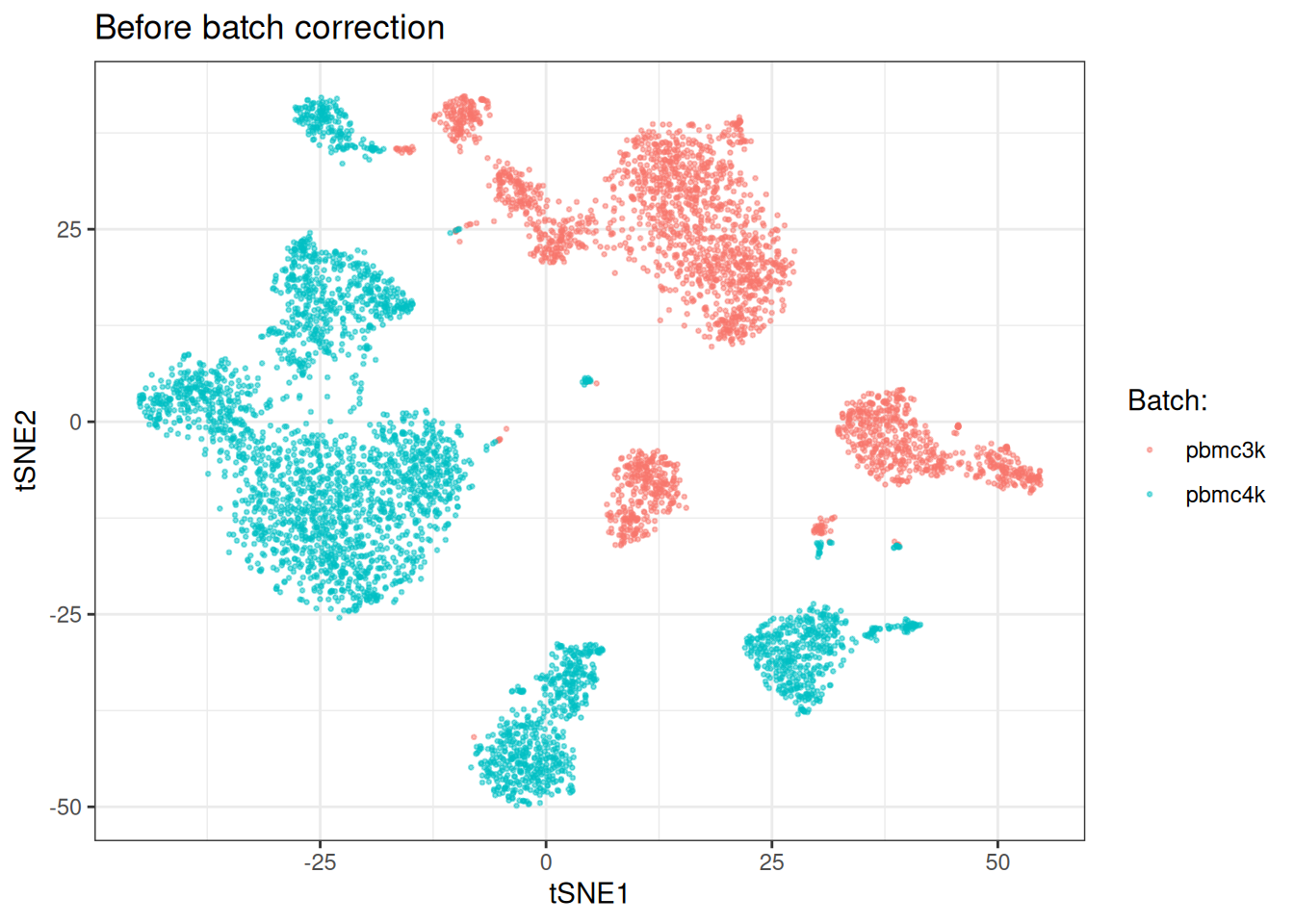
tSNE plot (tSNE’s usually look prettier… It’s anyway not a good way to assess batch effect correction, so at least let’s make it pleasant on the eye).
embedding_plot_sc(
  sc_object,
  embedding = "tsne",
  colour_by = "exp_id",
  label_by = "exp_id",
  discrete = TRUE
) +
  labs(
    title = "Before batch correction",
    colour = "Batch:"
  )
Each metric has its own function with its own print method. Here’s kBET on its own:
calculate_kbet_sc(sc_object, batch_column = "exp_id")
#> kBET Scores
#>   Cells: 5841 | Batches: 2 | Threshold: 0.050
#>   Rejection rate:      0.9885 (5774 / 5841)
#>   Mean Chi-Square:     12.8259 (expected under H0: 1)
#>   Median Chi-Square:   8.7578
In practice, you’d want all of them at once. calculate_integration_metrics_sc() gives one row per call, and we’ll stack one row per method into metrics_dt:
metrics_dt <- calculate_integration_metrics_sc(
  sc_object,
  batch_column = "exp_id",
  cell_type_column = "cell_type",
  .verbose = FALSE
) %>%
  .[, method := "Uncorrected"]

metrics_dt[]
#>    embedding kbet_accept batch_asw ilisi pcr_comparison clisi cell_type_asw
#>       <char>       <num>     <num> <num>          <num> <num>         <num>
#> 1:       pca  0.01147064 0.8909914     0             NA     1     0.6758695
#>    graph_connectivity      method
#>                 <num>      <char>
#> 1:          0.9894515 Uncorrected
The high kBET rejection rate (so a low kbet_accept) and a low ilisi confirm a substantial batch effect, and the tSNE shows clear separation by batch. pcr_comparison is NA here: it compares a corrected embedding against this PCA, so the PCA has nothing to compare against.
fastMNN
fastMNN works on batch-aware HVGs and produces a corrected embedding. It identifies mutual nearest neighbours across batches to compute correction vectors. For it to work best, we need the batch-aware HVGs. We will calculate these, provide them to fastMNN (which regenerates the PCA embedding based on the batch-aware HVG) and run then the actual algorithm
batch_aware_hvg <- find_hvg_batch_aware_sc(
  object = sc_object,
  batch_column = "exp_id"
)

sc_object <- fast_mnn_sc(
  object = sc_object,
  batch_hvg_genes = batch_aware_hvg$hvg_gene_idx,
  batch_column = "exp_id"
)

sc_object <- find_neighbours_sc(
  object = sc_object,
  embd_to_use = "mnn",
  neighbours_params = params_sc_neighbours()
)
#>
#> Generating sNN graph (full: TRUE).
#> Transforming sNN data to igraph.
metrics_dt <- rbind(
  metrics_dt,
  calculate_integration_metrics_sc(
    sc_object,
    batch_column = "exp_id",
    cell_type_column = "cell_type",
    embd_to_use = "mnn",
    .verbose = FALSE
  ) %>%
    .[, method := "fastMNN"]
)

metrics_dt[method == "fastMNN"]
#>    embedding kbet_accept batch_asw     ilisi pcr_comparison clisi cell_type_asw
#>       <char>       <num>     <num>     <num>          <num> <num>         <num>
#> 1:       mnn   0.6449238 0.9378912 0.3005779      0.8858816     1     0.6544492
#>    graph_connectivity  method
#>                 <num>  <char>
#> 1:          0.9972923 fastMNN
We can see clear improvements on the batch side: kBET acceptance, batch ASW and iLISI all go up.
sc_object <- tsne_sc(object = sc_object, slot_name = "tsne_mnn", use_knn = TRUE)
#> Running t-SNE.
#> Using provided kNN graph.
embedding_plot_sc(
  sc_object,
  embedding = "tsne_mnn",
  colour_by = "exp_id",
  label_by = "exp_id",
  discrete = TRUE
) +
  labs(
    title = "fastMNN batch correction",
    colour = "Batch:"
  )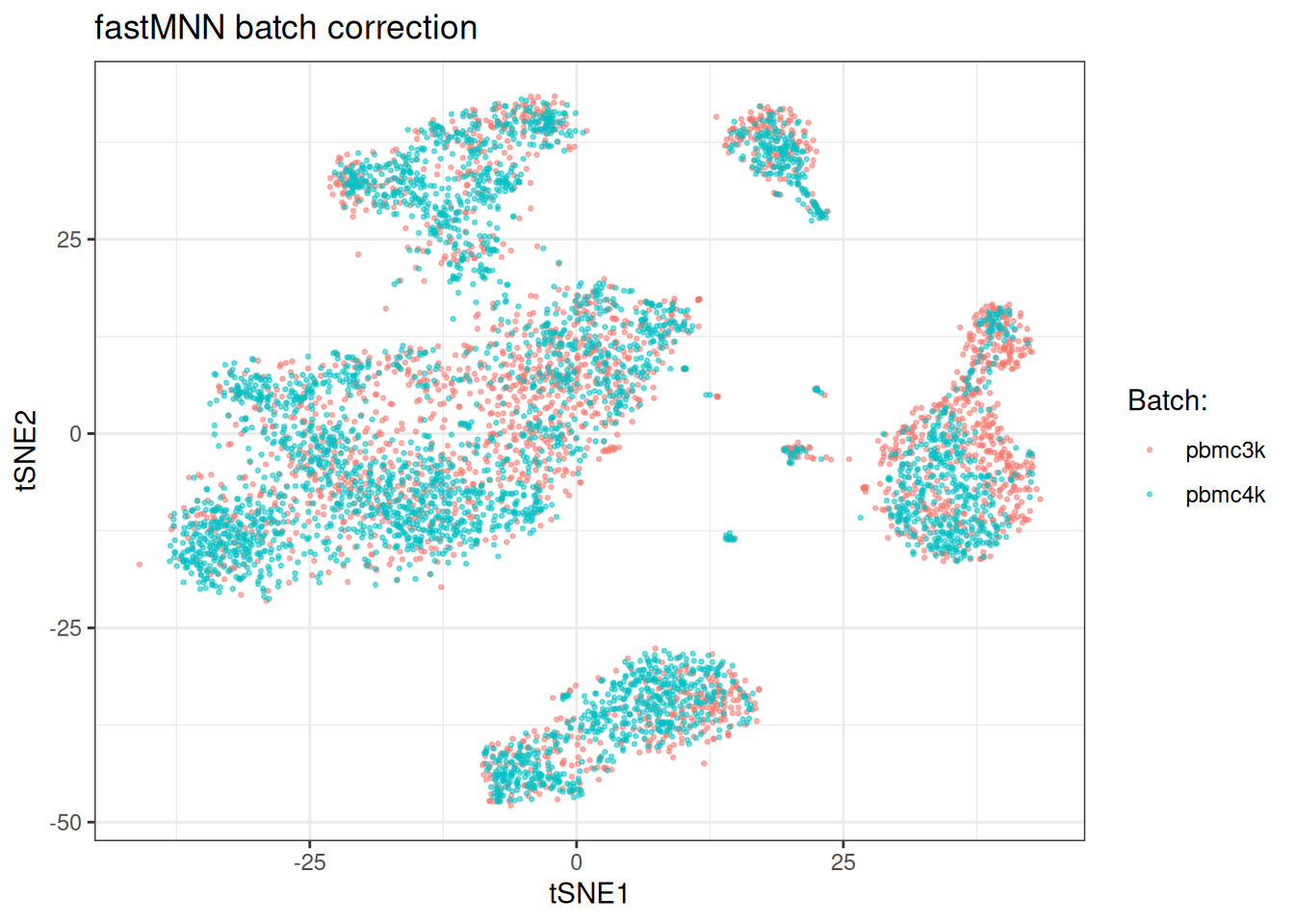
Also, visually the batches get mixed now.
Harmony
Harmony operates on the PCA embedding directly. The number of clusters is auto-determined from the dataset size (capped at 100) when left as NULL.
The two versions of Harmony are supported. Let’s start with the original:
Version 1
sc_object <- harmony_sc(
  object = sc_object,
  batch_column = "exp_id",
  harmony_params = params_sc_harmony()
)
#>  Auto-determined number of Harmony clusters: 100

sc_object <- find_neighbours_sc(
  object = sc_object,
  embd_to_use = "harmony",
  neighbours_params = params_sc_neighbours()
)
#>
#> Generating sNN graph (full: TRUE).
#> Transforming sNN data to igraph.
Let’s calculate the batch correction-related scores
metrics_dt <- rbind(
  metrics_dt,
  calculate_integration_metrics_sc(
    sc_object,
    batch_column = "exp_id",
    cell_type_column = "cell_type",
    embd_to_use = "harmony",
    .verbose = FALSE
  ) %>%
    .[, method := "Harmony"]
)

metrics_dt[method == "Harmony"]
#>    embedding kbet_accept batch_asw     ilisi pcr_comparison clisi cell_type_asw
#>       <char>       <num>     <num>     <num>          <num> <num>         <num>
#> 1:   harmony   0.8635508 0.9270978 0.6423357      0.9235805     1     0.6475996
#>    graph_connectivity  method
#>                 <num>  <char>
#> 1:           0.989357 Harmony
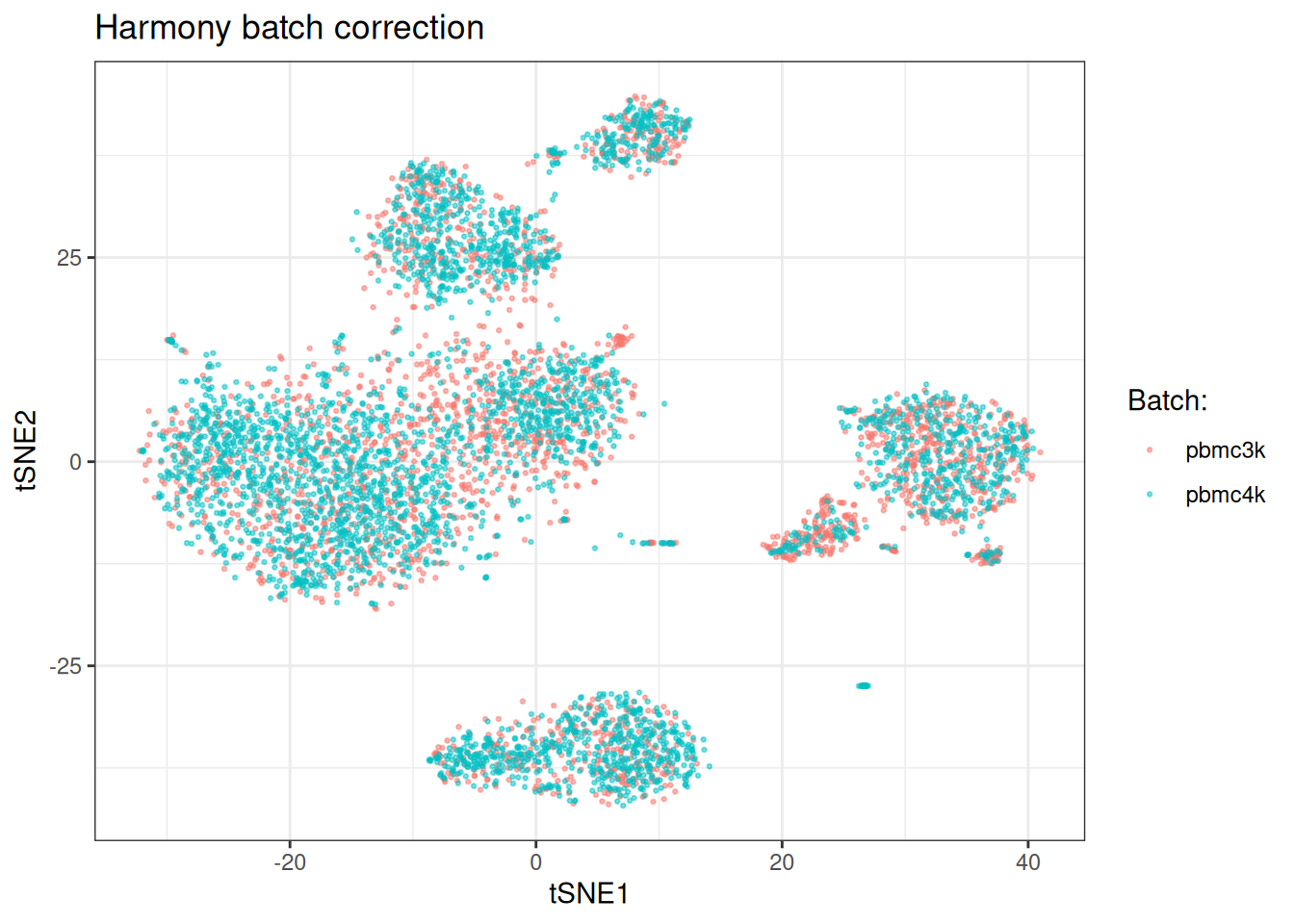
Also here, we observe improvements across the board.
sc_object <- tsne_sc(
  object = sc_object,
  slot_name = "tsne_harm",
  use_knn = TRUE
)
#> Running t-SNE.
#> Using provided kNN graph.
embedding_plot_sc(
  sc_object,
  embedding = "tsne_harm",
  colour_by = "exp_id",
  label_by = "exp_id",
  discrete = TRUE
) +
  labs(
    title = "Harmony batch correction",
    colour = "Batch:"
  )
Version 2
Compared to v1 of Harmony, several modifications/improvements were implemented by Patikas, et al., 2026, namely:
- Stabilised diversity penalty
- Batch pruning in ridge regression
- Arrowhead matrix inversion for single-covariate case (making it faster!)
- Dynamic lambda estimation and theta scaling by batch size.
Overall, this makes v2 more amenable and faster on big data sets than v1 (if you wish to use Harmony, maybe use the version 2 over the v2?).
sc_object <- harmony_v2_sc(
  object = sc_object,
  batch_column = "exp_id",
  harmony_params = params_sc_harmony_v2()
)
#>  Auto-determined number of Harmony clusters: 100

sc_object <- find_neighbours_sc(
  object = sc_object,
  embd_to_use = "harmony_v2",
  neighbours_params = params_sc_neighbours()
)
#>
#> Generating sNN graph (full: TRUE).
#> Transforming sNN data to igraph.
Let’s calculate the batch correction-related scores
metrics_dt <- rbind(
  metrics_dt,
  calculate_integration_metrics_sc(
    sc_object,
    batch_column = "exp_id",
    cell_type_column = "cell_type",
    embd_to_use = "harmony_v2",
    .verbose = FALSE
  ) %>%
    .[, method := "Harmony v2"]
)

metrics_dt[method == "Harmony v2"]
#>     embedding kbet_accept batch_asw     ilisi pcr_comparison clisi
#>        <char>       <num>     <num>     <num>          <num> <num>
#> 1: harmony_v2   0.8604691 0.9189611 0.6423357      0.8947809     1
#>    cell_type_asw graph_connectivity     method
#>            <num>              <num>     <char>
#> 1:     0.6957045          0.9879408 Harmony v2
sc_object <- tsne_sc(
  object = sc_object,
  slot_name = "tsne_harm_v2",
  use_knn = TRUE
)
#> Running t-SNE.
#> Using provided kNN graph.
embedding_plot_sc(
  sc_object,
  embedding = "tsne_harm_v2",
  colour_by = "exp_id",
  label_by = "exp_id",
  discrete = TRUE
) +
  labs(
    title = "Harmony (version 2) batch correction",
    colour = "Batch:"
)%20plot-1.png)
Seurat CCA
Seurat’s anchor methods take a different route. For each pair of batches they find cells that are mutual nearest neighbours in a shared space, treat those pairs as anchors, score them by how much of their neighbourhood they share, and then apply a kernel-weighted correction that pulls the query batch onto the reference. Batches get merged in the order of their pairwise anchor counts.
For CCA the shared space is a canonical correlation embedding computed per batch pair. Anchors also get filtered in gene space before scoring, which is CCA-only in Seurat.
A few things differ from Seurat’s reference implementation:
- The per-gene
ScaleDatastep is skipped. We work directly from per-cell standardised log-normalised HVG expression. -
M = X1^T @ X2is never materialised. The canonical correlations come from a matrix-free randomised SVD, so memory stays atO((n1 + n2) * num_cc)rather thann1 x n2. On big batch pairs that is the difference between running and not running. - The correction is applied to the embedding (dims x cells), not to full log-expression.
- The effective CC rank is
max(num_cc, dims), notnum_cc.
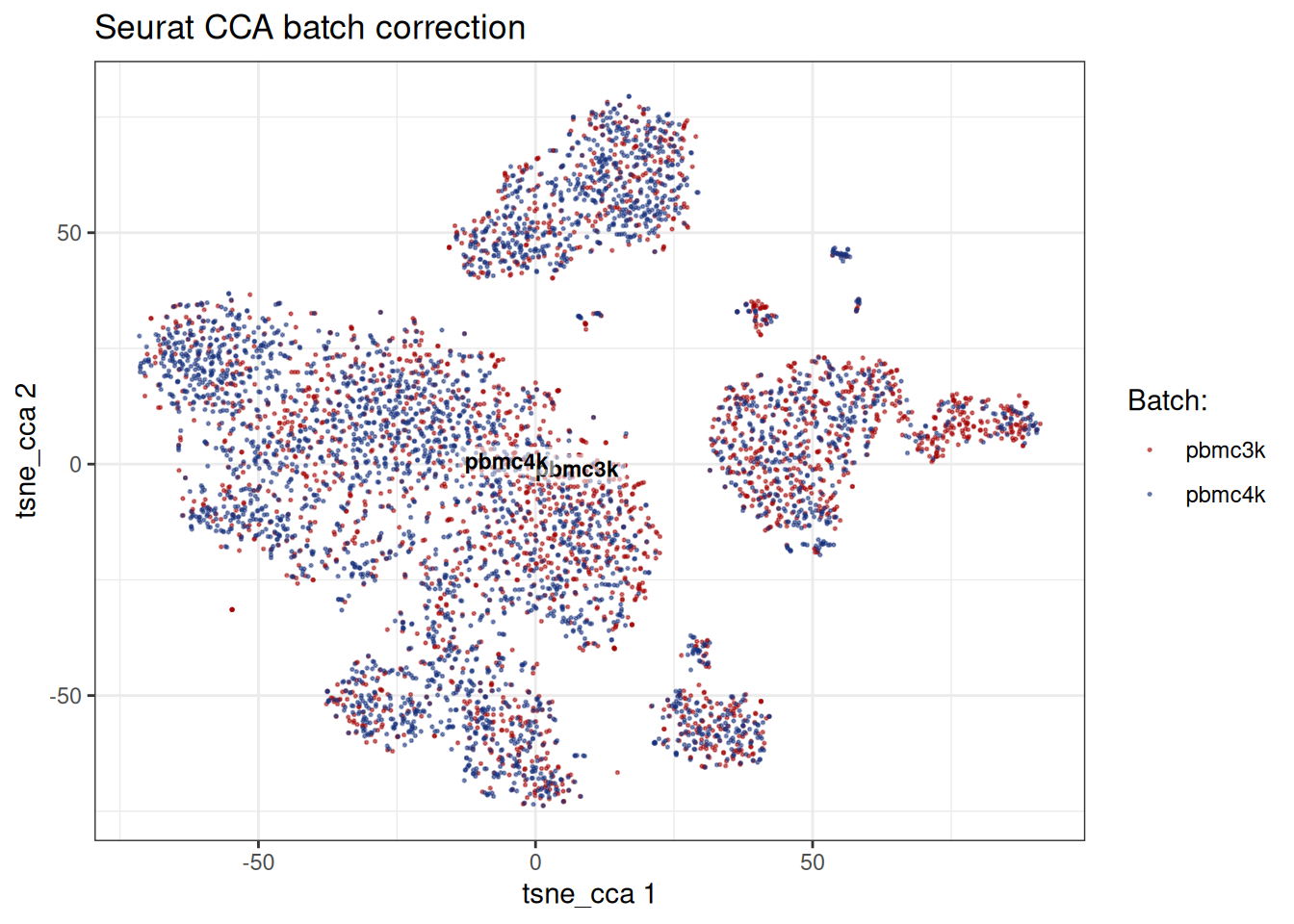
Anchor structure comes out close to identical. Like fastMNN, CCA wants batch-aware HVGs, so we reuse the ones computed above.
sc_object <- seurat_cca_sc(
  object = sc_object,
  batch_hvg_genes = batch_aware_hvg$hvg_gene_idx,
  batch_column = "exp_id"
)

sc_object <- find_neighbours_sc(
  object = sc_object,
  embd_to_use = "cca",
  neighbours_params = params_sc_neighbours()
)
#>
#> Generating sNN graph (full: TRUE).
#> Transforming sNN data to igraph.
metrics_dt <- rbind(
  metrics_dt,
  calculate_integration_metrics_sc(
    sc_object,
    batch_column = "exp_id",
    cell_type_column = "cell_type",
    embd_to_use = "cca",
    .verbose = FALSE
  ) %>%
    .[, method := "Seurat CCA"]
)

metrics_dt[method == "Seurat CCA"]
#>    embedding kbet_accept batch_asw     ilisi pcr_comparison clisi cell_type_asw
#>       <char>       <num>     <num>     <num>          <num> <num>         <num>
#> 1:       cca   0.6856703 0.8886744 0.4705881      0.8693617     1     0.6997823
#>    graph_connectivity     method
#>                 <num>     <char>
#> 1:          0.9894515 Seurat CCA
sc_object <- tsne_sc(object = sc_object, slot_name = "tsne_cca", use_knn = TRUE)
#> Running t-SNE.
#> Using provided kNN graph.
embedding_plot_sc(
  sc_object,
  embedding = "tsne_cca",
  colour_by = "exp_id",
  label_by = "exp_id",
  discrete = TRUE
) +
  labs(
    title = "Seurat CCA batch correction",
    colour = "Batch:"
  )
Seurat rPCA
rPCA runs the same anchor pipeline on a cheaper shared space. Instead of computing canonical correlations, each batch keeps its own PCA basis and the other batch’s expression is projected into it. Cross-batch neighbour queries then happen in these projected bases.
The trade-off is the usual one: rPCA is faster and corrects less aggressively, which makes it the safer choice when your batches share most of their cell types. CCA is the one to reach for when they don’t. As in Seurat, no gene-space anchor filter runs here, that step is CCA-only.
sc_object <- seurat_rpca_sc(
  object = sc_object,
  batch_hvg_genes = batch_aware_hvg$hvg_gene_idx,
  batch_column = "exp_id"
)

sc_object <- find_neighbours_sc(
  object = sc_object,
  embd_to_use = "rpca",
  neighbours_params = params_sc_neighbours()
)
#>
#> Generating sNN graph (full: TRUE).
#> Transforming sNN data to igraph.
metrics_dt <- rbind(
  metrics_dt,
  calculate_integration_metrics_sc(
    sc_object,
    batch_column = "exp_id",
    cell_type_column = "cell_type",
    embd_to_use = "rpca",
    .verbose = FALSE
  ) %>%
    .[, method := "Seurat rPCA"]
)

metrics_dt[method == "Seurat rPCA"]
#>    embedding kbet_accept batch_asw     ilisi pcr_comparison clisi cell_type_asw
#>       <char>       <num>     <num>     <num>          <num> <num>         <num>
#> 1:      rpca   0.7752097 0.9051192 0.6423357       0.810686     1      0.691866
#>    graph_connectivity      method
#>                 <num>      <char>
#> 1:          0.9894043 Seurat rPCA
sc_object <- tsne_sc(
  object = sc_object,
  slot_name = "tsne_rpca",
  use_knn = TRUE
)
#> Running t-SNE.
#> Using provided kNN graph.
embedding_plot_sc(
  sc_object,
  embedding = "tsne_rpca",
  colour_by = "exp_id",
  label_by = "exp_id",
  discrete = TRUE
) +
  labs(
    title = "Seurat rPCA batch correction",
    colour = "Batch:"
  )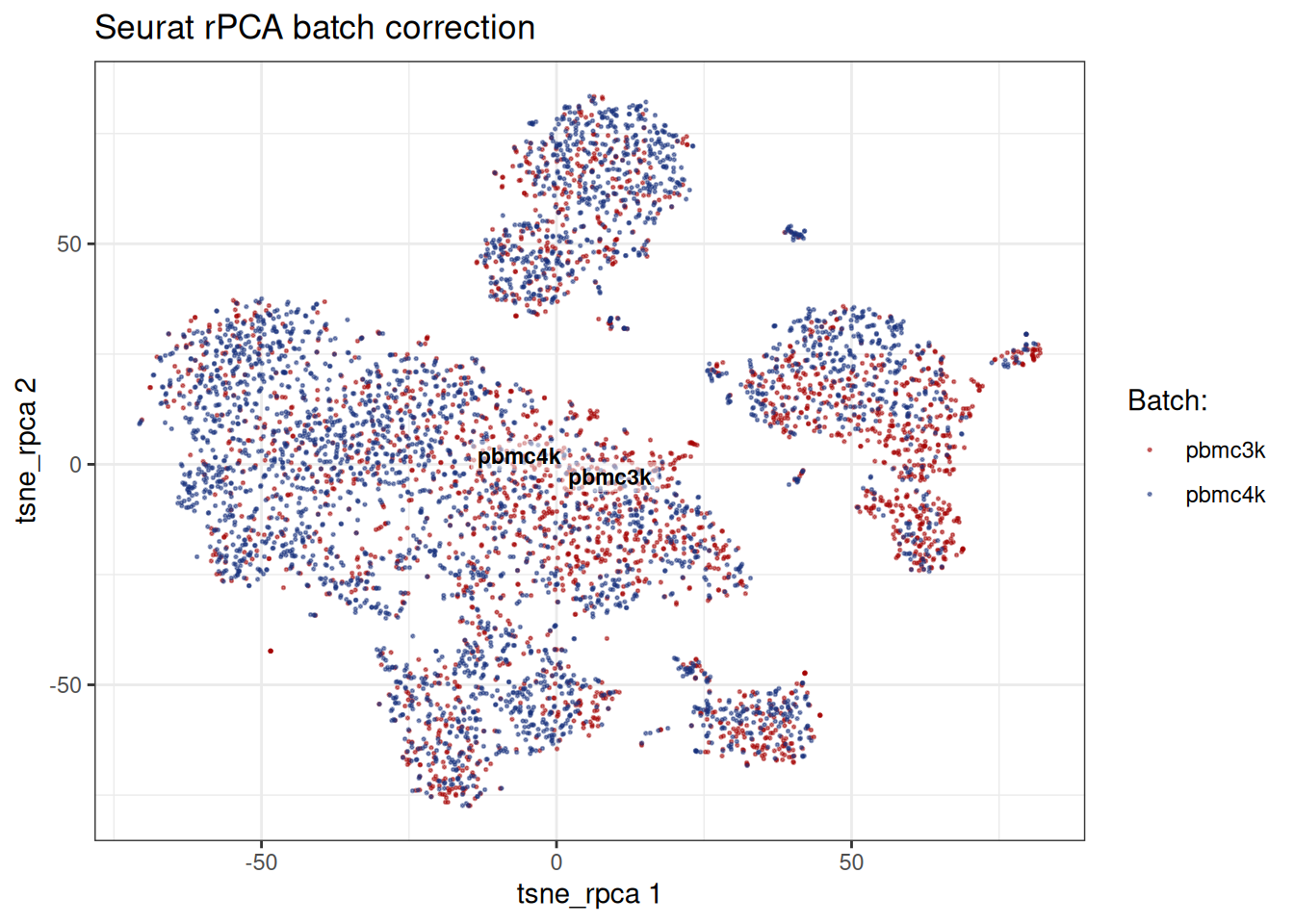
One caveat worth knowing about both anchor methods: on data that already mixes well they have nothing to gain, and the correction can nudge the batch metrics slightly in the wrong direction while still sharpening the cell type structure. Check your uncorrected metrics before reaching for them.
BBKNN
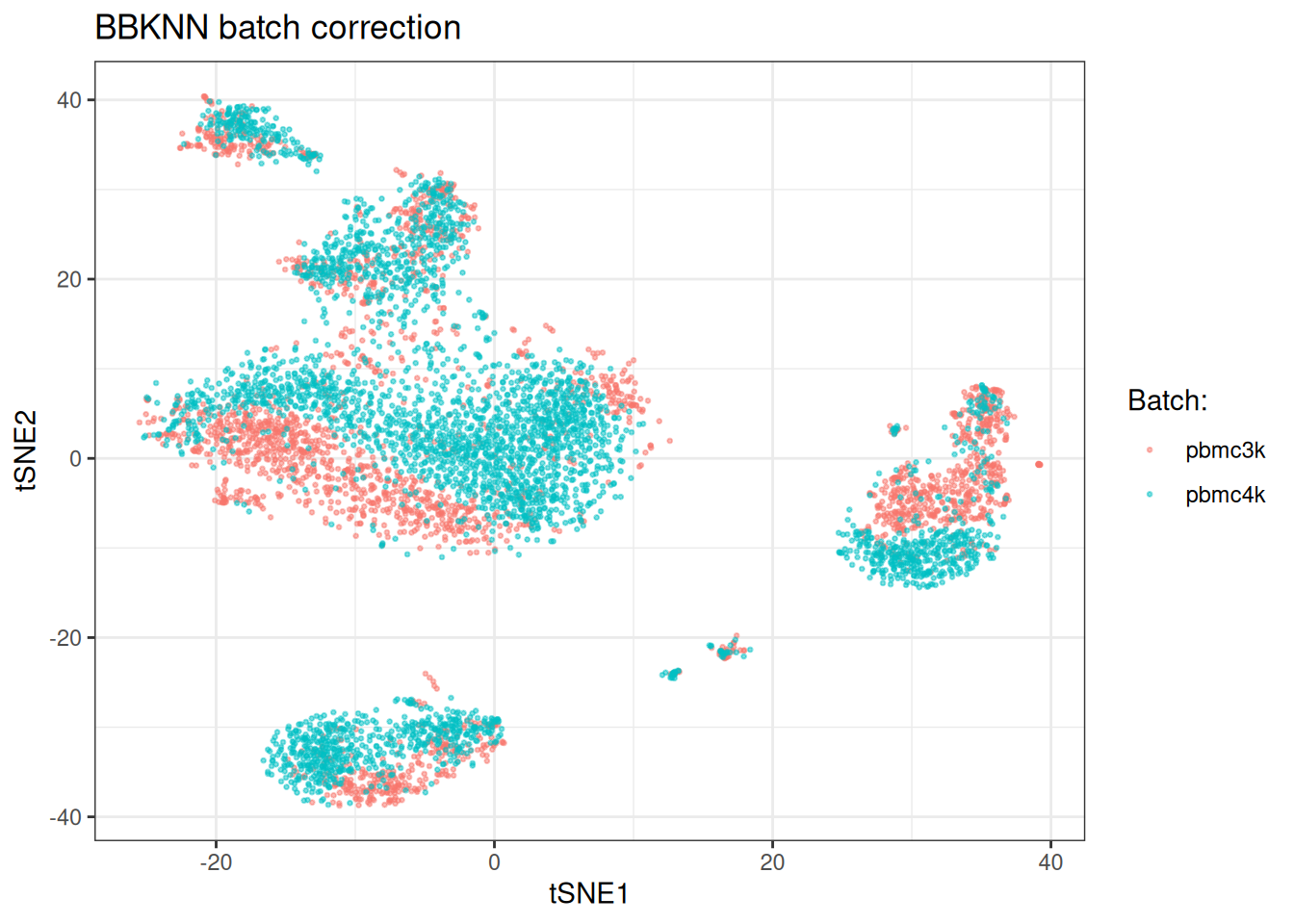
BBKNN constructs a batch-balanced kNN graph rather than correcting an embedding. The key parameter is neighbours_within_batch, which controls how many neighbours are found per batch. Setting no_neighbours_to_keep below the total generated neighbours (here 10 from 2 batches = 20 total) ensures the distance-based filtering introduces genuine variation, making downstream metrics informative.
Note that kBET and the embedding metrics are not well suited for evaluating BBKNN: kBET compares neighbourhood proportions against global proportions, which BBKNN manipulates by design, and ASW and PCR need an embedding. BBKNN only hands back a graph, so we pass embd_to_use = NULL and those columns come back NA. iLISI, cLISI and graph connectivity on the stored kNN are the ones to read here.
sc_object <- bbknn_sc(
  object = sc_object,
  batch_column = "exp_id",
  no_neighbours_to_keep = 15L,
  bbknn_params = params_sc_bbknn(neighbours_within_batch = 10L)
)
#> Warning in `method(bbknn_sc, bixverse::SingleCells)`(object = <object>, : Prior
#> kNN matrix found. Will be overwritten.
#> Running BBKNN algorithm.
#> Generating graph based on BBKNN connectivities. Weights will be based on the connectivities and not shared nearest neighbour calculations.
metrics_dt <- rbind(
  metrics_dt,
  calculate_integration_metrics_sc(
    sc_object,
    batch_column = "exp_id",
    cell_type_column = "cell_type",
    embd_to_use = NULL,
    .verbose = FALSE
  ) %>%
    .[, method := "BBKNN"]
)

metrics_dt[method == "BBKNN"]
#>    embedding kbet_accept batch_asw ilisi pcr_comparison clisi cell_type_asw
#>       <char>       <num>     <num> <num>          <num> <num>         <num>
#> 1:      <NA>           1        NA   0.8             NA     1            NA
#>    graph_connectivity method
#>                 <num> <char>
#> 1:          0.9755626  BBKNN
sc_object <- tsne_sc(object = sc_object, use_knn = TRUE)
#> Running t-SNE.
#> Using provided kNN graph.
embedding_plot_sc(
  sc_object,
  embedding = "tsne",
  colour_by = "exp_id",
  label_by = "exp_id",
  discrete = TRUE
) +
  labs(
    title = "BBKNN batch correction",
    colour = "Batch:"
  )
Choosing a method
Here’s everything side by side:
metrics_dt[, .(
  method,
  kbet_accept,
  batch_asw,
  ilisi,
  pcr_comparison,
  clisi,
  cell_type_asw,
  graph_connectivity
)]
#>         method kbet_accept batch_asw     ilisi pcr_comparison clisi
#>         <char>       <num>     <num>     <num>          <num> <num>
#> 1: Uncorrected  0.01147064 0.8909914 0.0000000             NA     1
#> 2:     fastMNN  0.64492381 0.9378912 0.3005779      0.8858816     1
#> 3:     Harmony  0.86355076 0.9270978 0.6423357      0.9235805     1
#> 4:  Harmony v2  0.86046910 0.9189611 0.6423357      0.8947809     1
#> 5:  Seurat CCA  0.68567026 0.8886744 0.4705881      0.8693617     1
#> 6: Seurat rPCA  0.77520972 0.9051192 0.6423357      0.8106860     1
#> 7:       BBKNN  1.00000000        NA 0.8000000             NA     1
#>    cell_type_asw graph_connectivity
#>            <num>              <num>
#> 1:     0.6758695          0.9894515
#> 2:     0.6544492          0.9972923
#> 3:     0.6475996          0.9893570
#> 4:     0.6957045          0.9879408
#> 5:     0.6997823          0.9894515
#> 6:     0.6918660          0.9894043
#> 7:            NA          0.9755626
bio_metrics <- c("clisi", "cell_type_asw", "graph_connectivity")

metrics_long <- melt(
  metrics_dt[, -"embedding"],
  id.vars = "method",
  variable.name = "metric",
  value.name = "score"
) %>%
  .[, `:=`(
    method = factor(method, levels = rev(unique(metrics_dt$method))),
    type = fifelse(metric %in% bio_metrics, "Bio conservation", "Batch mixing")
  )]

ggplot(metrics_long, aes(x = metric, y = method, fill = score)) +
  geom_tile(colour = "white") +
  geom_text(
    aes(label = fifelse(is.na(score), "", sprintf("%.2f", score))),
    size = 3
  ) +
  facet_grid(~type, scales = "free_x", space = "free_x") +
  scale_fill_distiller(
    palette = "Blues",
    direction = 1,
    na.value = "grey90",
    limits = c(0, 1),
    oob = scales::squish
  ) +
  theme_minimal() +
  theme(axis.text.x = element_text(angle = 45, hjust = 1)) +
  labs(x = NULL, y = NULL, fill = "Score", title = "Integration metrics")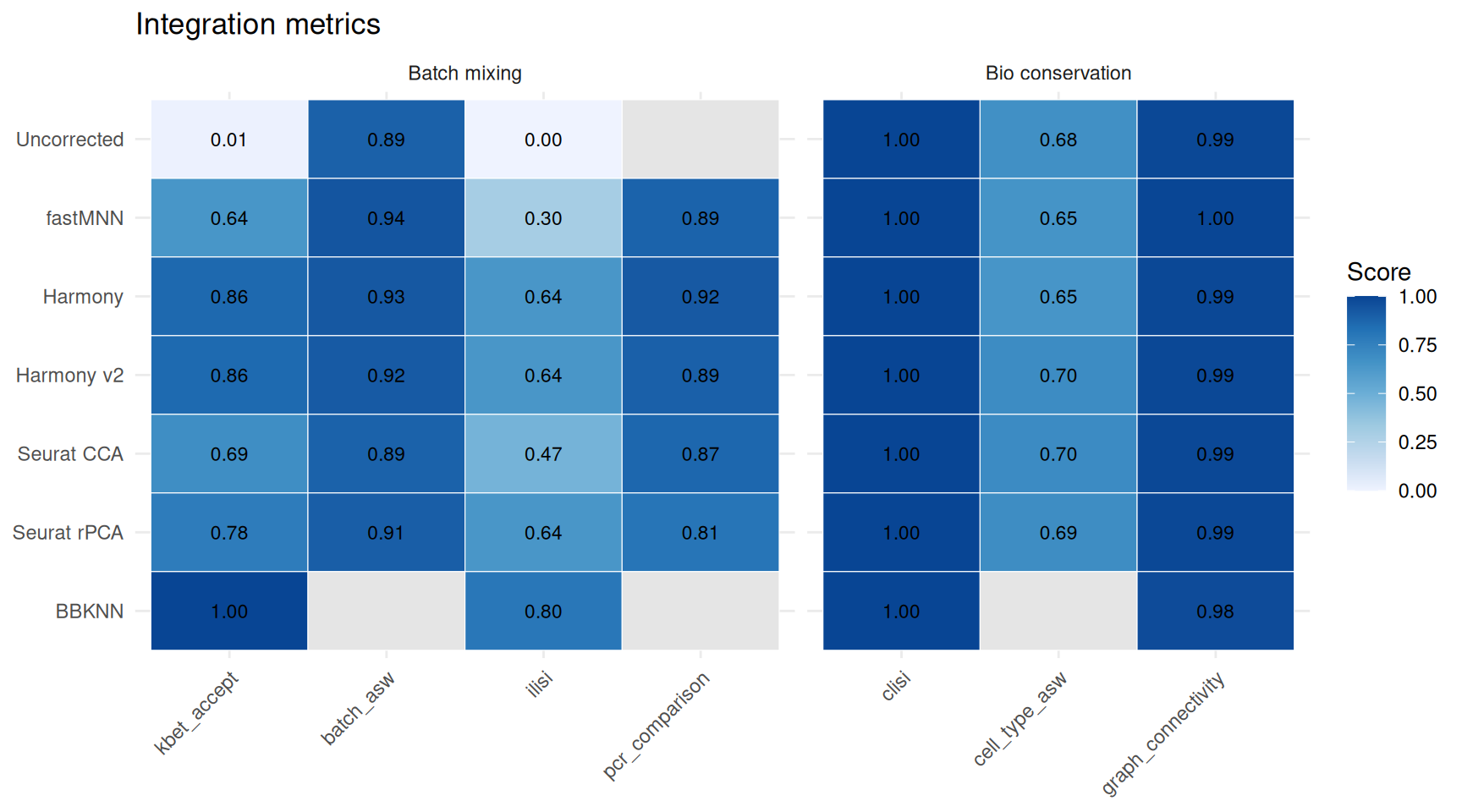
Read the two panels together. A method that tops batch mixing but drops on bio conservation has merged cell types along with the batches, which is worse than doing nothing.
Two of these tell you little on this data set. cLISI sits at 1 for every method: six coarse, well separated cell types keep their neighbourhoods pure no matter what. Batch ASW barely moves either, since two PBMC batches of the same tissue never separate much on silhouette to begin with. Both earn their keep on finer labels and nastier batch effects. On two PBMC runs, kBET, iLISI and PCR do the talking. And BBKNN’s perfect kBET is the artefact mentioned above, not a win.
There is no universally best batch correction method. Some practical guidance:
Harmony is a good default. It is fast, operates on the PCA embedding directly, and handles multiple batch variables simultaneously. It tends to work well when batch effects are moderate and cell type composition is broadly similar across batches. Version 2 is quite an improvement and necessitates less that the same cells are available across the batches and is substantially faster when you provide only one batch effect to regress out.
fastMNN is worth considering when cell type composition differs substantially across batches. The mutual nearest neighbour approach is less sensitive to this because it only aligns cells that have a plausible biological match in another batch.
Seurat CCA and rPCA are the anchor-based options. Like fastMNN they only align cells with a plausible match in another batch, so they hold up when cell type composition differs. They are the heaviest of the five though, and on data that already mixes well they can make the batch metrics slightly worse. rPCA is the cheaper and gentler of the two and a sensible default; go to CCA when the batches genuinely don’t share their cell types.
BBKNN is useful when you want to avoid modifying the embedding at all. The batch-balanced graph can be passed directly to graph-based clustering algorithms. It is the lightest-touch approach but provides less control over the degree of correction.
In practice, running multiple methods and looking at quantitative metrics is the most reliable approach. No single metric captures everything: kBET and PCR only see batch, cLISI and cell type ASW only see biology, and the ones built on the kNN graph are the only fair comparison for graph-based methods like BBKNN. UMAPs and tSNE assessments should be taken with a big pinch of salt, see Chari, et al. Admittedly, they do look pretty however.
Clean up
unlink(tempdir_batch_cor, recursive = TRUE, force = TRUE)