library(bixverse)
library(data.table)
#>
#> Attaching package: 'data.table'
#> The following object is masked from 'package:base':
#>
#>     %notin%
Doublet detection with bixverse
2026-09-24
Intro
Doublets - droplets containing two or more cells - are a common artefact in droplet-based single cell experiments. If left undetected, they masquerade as intermediate cell states or novel populations and quietly corrupt downstream analyses. This vignette demonstrates three doublet detection approaches available in bixverse and benchmarks them against ground truth calls from demuxlet, which identifies doublets via genetic variation across pooled donors.
bixverse provides three computational doublet detection methods:
Scrublet is a simulation-based approach (Wolock, et al., 2019). It generates synthetic doublets by averaging pairs of randomly selected cells, embeds both real and synthetic cells together, and scores each real cell by the proportion of its nearest neighbours that are synthetic. A bimodal score distribution is expected: singlets cluster near zero, doublets near one. A threshold on this score determines the final calls.
Boosted doublet detection takes a different angle. Rather than simulating doublets, it trains a gradient-boosted tree ensemble to distinguish real cells from synthetic doublets generated in the same way as Scrublet. The classifier produces a probability per cell, and doublet calls are derived from that probability. This can be more robust when the score distribution from Scrublet is not cleanly bimodal, though it introduces its own hyperparameters (and is substantially slower).
scDblFinder is a port of the scDblFinder method from Germain et al., with one modification: it uses lightGBM with the histogram trick on the feature space instead of xgboost, which tends to be faster to fit. Like the boosted approach it trains a classifier on real versus synthetic doublets, but it combines the classifier output with cxds co-expression scores (Bais and Kostka) into a weighted final score. Across published benchmarks it tends to be the strongest of the three.
All three methods are purely computational and work without genetic or hashing information. They complement experimental approaches like demuxlet, which require pooled donors or hashtag antibodies. They also have a failure mode if a large number of doublets dominates the original data.
Loading the data
We use a PBMC data set with demuxlet ground truth calls. The demuxlet output classifies each barcode as a singlet (SNG) or doublet (DBL) (or ambiguous, but irrelevant for this situation), giving us something to benchmark against.
doublet_path <- download_demuxlet_pbmc()

tempdir_doublet <- file.path(tempdir(), "demuxlet_bixverse")
dir.create(tempdir_doublet, showWarnings = FALSE, recursive = TRUE)

demuxlet_data <- fread(file.path(doublet_path, "demuxlet_calls.tsv"))

table(demuxlet_data$Call)
#>
#>   AMB   DBL   SNG
#>    24  1565 13030
Load in the data into bixverse
sc_object <- SingleCells(dir_data = tempdir_doublet)

mtx_io_params <- get_cell_ranger_params(doublet_path)
mtx_io_params$cells_as_rows <- TRUE

sc_object <- load_mtx(
  object = sc_object,
  sc_mtx_io_param = mtx_io_params,
  streaming = 0L
)
#>  Loading data directly into memory for CSR to CSC conversion.
#> Loading observations data from flat file into the DuckDB.
#> Loading variable data from flat file into the DuckDB.

sc_object
#> Single cell experiment (Single Cells).
#>   No cells (original): 14528
#>    To keep n: 14528
#>   No genes: 12622
#>   HVG calculated: FALSE
#>   PCA calculated: FALSE
#>   Other embeddings: none
#>   KNN generated: FALSE
#>   SNN generated: FALSE
#>   MAGIC imputed: none
#>   Residual model: none
#>   Stale artefacts: none
We also define a small helper to compute precision, recall and F1 against the demuxlet calls.
doublet_metrics <- function(
  predicted,
  actual,
  pos_predicted = TRUE,
  pos_actual = "DBL"
) {
  tp <- sum(predicted == pos_predicted & actual == pos_actual)
  fp <- sum(predicted == pos_predicted & actual != pos_actual)
  fn <- sum(predicted != pos_predicted & actual == pos_actual)
  precision <- tp / (tp + fp)
  recall <- tp / (tp + fn)
  f1 <- 2 * (precision * recall) / (precision + recall)
  list(precision = precision, recall = recall, f1 = f1)
}
Doublet detection methods
Let’s check the two methods out and see how they behave
Scrublet
scrublet <- scrublet_sc(
  object = sc_object,
  scrublet_params = params_scrublet(expected_doublet_rate = 0.12)
)

scrublet
#> ScrubletRes: 14528 cells, 1779 doublets (12.2%)
#>   Threshold:              0.2141
#>   Detected doublet rate:  12.2%
#>   Detectable fraction:    88.2%
#>   Overall doublet rate:   13.9%
#>   Simulated doublets:     21792
The plot method shows the score distribution for observed and simulated cells. A clean separation between the two modes indicates the threshold is sensible.
plot(scrublet)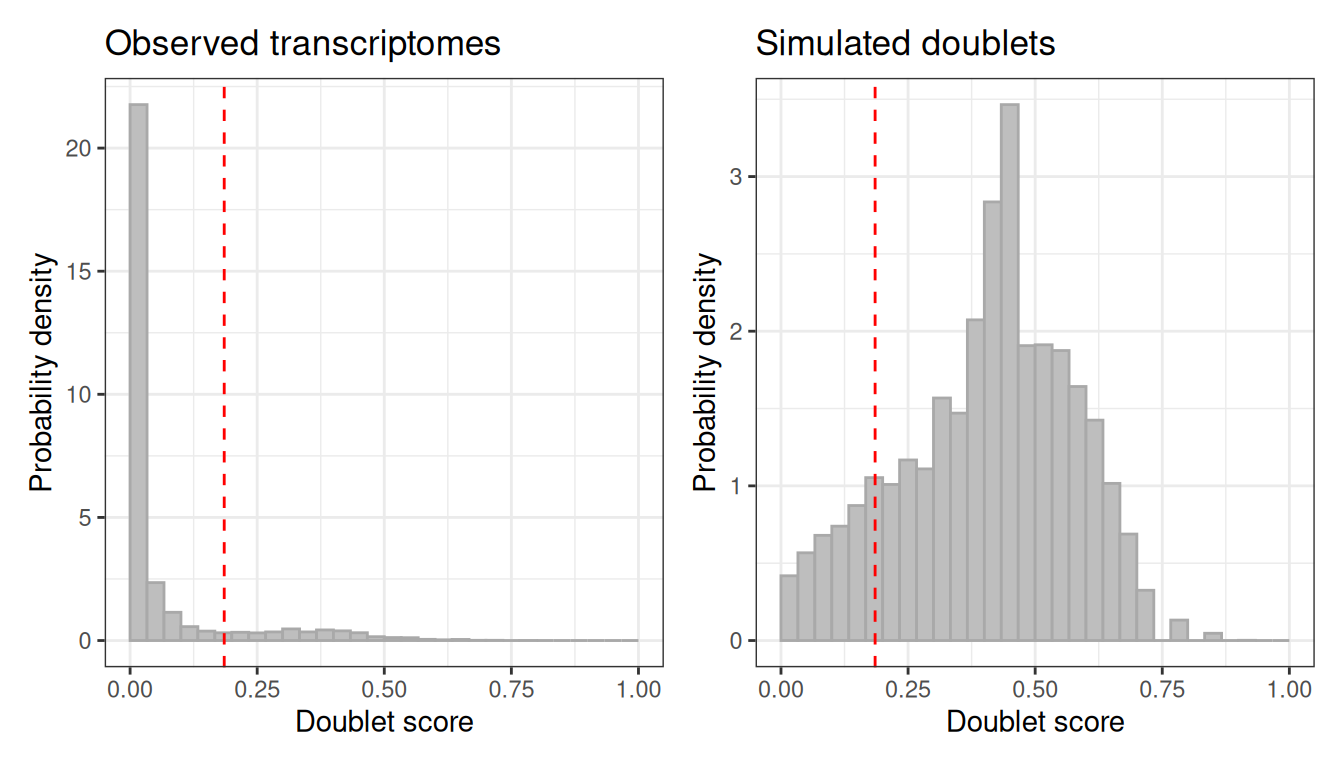
How does the automatic thresholding perform against the demuxlet ground truth?
scrublet_dt <- get_data(scrublet)
scrublet_dt[, Barcode := get_cell_names(sc_object)]
scrublet_dt <- merge(scrublet_dt, demuxlet_data, by = "Barcode")

doublet_metrics(predicted = scrublet_dt$doublet, actual = scrublet_dt$Call)
#> $precision
#> [1] 0.6649803
#>
#> $recall
#> [1] 0.7588198
#>
#> $f1
#> [1] 0.7088077
If you want to add the information to the DuckDB within the object, you can just run:
sc_object <- add_sc_new_obs(
  object = sc_object,
  obs_data = get_data(scrublet)
)

head(sc_object)
#>    cell_idx          cell_id   nnz lib_size to_keep doublet doublet_score
#>       <num>           <char> <num>    <num>  <lgcl>  <lgcl>         <num>
#> 1:        1 AAACATACAATGCC-1   851     1313    TRUE    TRUE  0.4036143720
#> 2:        2 AAACATACATTTCC-1   876     1537    TRUE   FALSE  0.0477031805
#> 3:        3 AAACATACCAGAAA-1   713     1149    TRUE   FALSE  0.0236686375
#> 4:        4 AAACATACCAGCTA-1   948     1588    TRUE   FALSE  0.1923076808
#> 5:        5 AAACATACCATGCA-1   337      499    TRUE   FALSE  0.0006016847
#> 6:        6 AAACATACCTCGCT-1   849     1494    TRUE   FALSE  0.0335463248
As we can see with added now the Scrublet data
Manual threshold adjustment
The automatic threshold does not always land in the right place. If the score distribution suggests a different cut-off, call_doublets_manual lets you override it.
scrublet_adj <- call_doublets_manual(scrublet, threshold = 0.25)
#> Detected doublet rate = 11.2%
#> Estimated detectable doublet fraction = 84.9%
#> Overall doublet rate:
#>   Estimated = 13.2%

plot(scrublet_adj)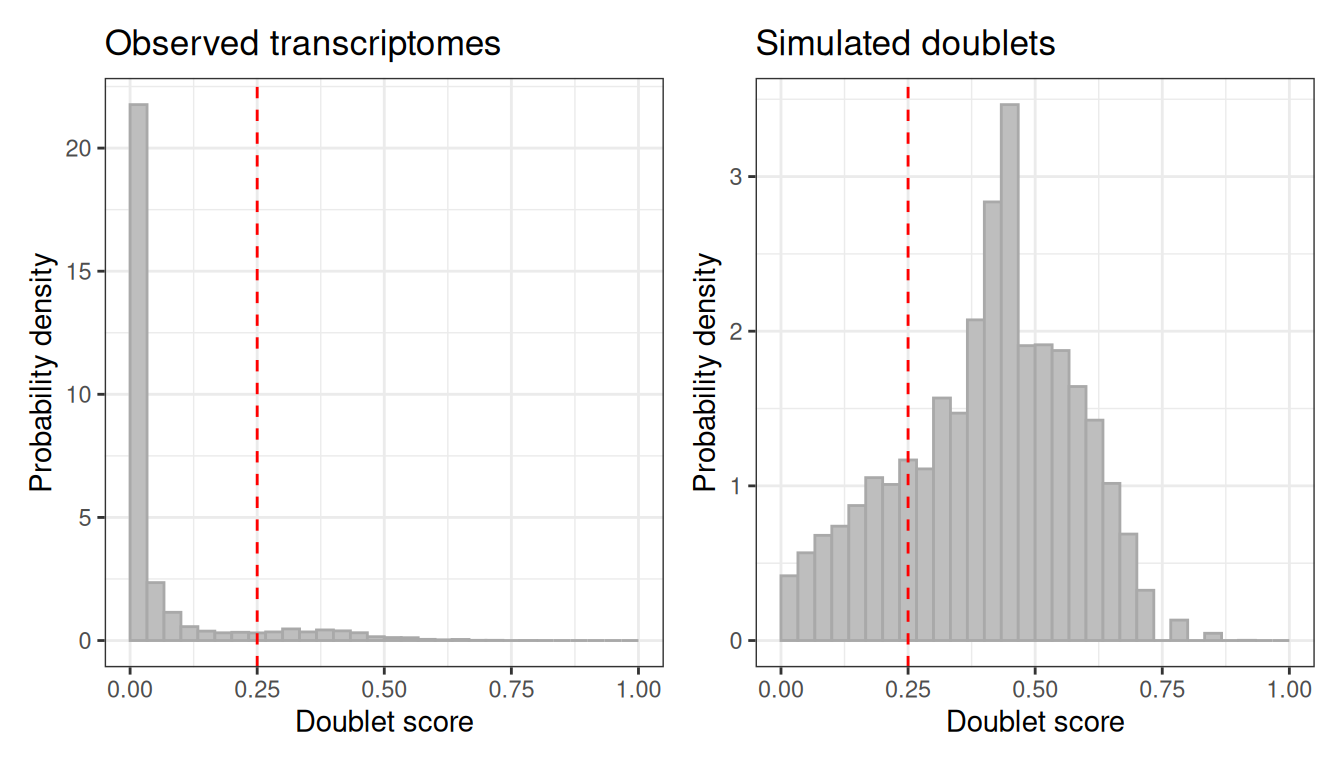
scrublet_adj_dt <- get_data(scrublet_adj)
scrublet_adj_dt[, Barcode := get_cell_names(sc_object)]
scrublet_adj_dt <- merge(scrublet_adj_dt, demuxlet_data, by = "Barcode")

doublet_metrics(
  predicted = scrublet_adj_dt$doublet,
  actual = scrublet_adj_dt$Call
)
#> $precision
#> [1] 0.6820418
#>
#> $recall
#> [1] 0.7113534
#>
#> $f1
#> [1] 0.6963893
We have made it worse here, but maybe there are cases where the scores are not very good. Compared to the original version, Otsu’s method is used to identify the perfect threshold, but it might fail in some situations.
Running with grouping variables or within specific cell subsets
Scrublet (and the other methods) have the two parameters if you wish to run the detection method within a specific set of cells (see the cells_to_use = NULL parameter )and/or want to use a grouping variable (like run the doublet detection within individual samples, see the group_by = NULL parameter).
Boosted doublet detection
The boosted approach trains a classifier to separate real cells from synthetic doublets. This can work better when the Scrublet score distribution is messy or unimodal. However, in this case we are running 25 iterations of the algorithm, which means 20x generation of synthetic doublets. The initial PCA will be stored in the object for subsequent reprojection - nonetheless, this makes this usually slower than the other methods in this vignette.
boosted_doublets <- doublet_detection_boost_sc(
  object = sc_object,
  boost_params = params_boost()
)
Let’s check how boosted works?
boosted_dt <- get_data(boosted_doublets)
boosted_dt[, Barcode := get_cell_names(sc_object)]
boosted_dt <- merge(boosted_dt, demuxlet_data, by = "Barcode")

doublet_metrics(predicted = boosted_dt$doublet, actual = boosted_dt$Call)
#> $precision
#> [1] 0.68523
#>
#> $recall
#> [1] 0.5445799
#>
#> $f1
#> [1] 0.606862
Overall, it takes longer and has worse performance (in this data set). If you wish to have a partially orthogonal method, it can be worthwhile nonetheless. There is also an option to accelerate the algorithm via fast clustering. This will run k-means clustering with sqrt(n_cells) * 4 centroids by default, run the kNN on these subset of centroids, Louvain on the smaller kNN and project back the Louvain membership for final scoring. However, this comes at cost of Recall, as you can see below. Generally speaking, you need to see how many centroids you need to represent your data properly. On smaller data sets, you can get away with n_cells / 10 and compress 10 cells into one centroid… On larger data sets, you might want to compress further.
boosted_doublets_fast <- doublet_detection_boost_sc(
  object = sc_object,
  boost_params = params_boost(
    fast_cluster = TRUE,
    # in this case, we set the n_centroids to N_cells / 10
    # you want this to not be too low; also the data is so small, we just
    # use standard k-means over mini batch
    fast_cluster_params = list(n_centroids = 1500L, km_type = "standard")
  )
)
boosted_fast_dt <- get_data(boosted_doublets_fast)
boosted_fast_dt[, Barcode := get_cell_names(sc_object)]
boosted_fast_dt <- merge(boosted_fast_dt, demuxlet_data, by = "Barcode")

doublet_metrics(
  predicted = boosted_fast_dt$doublet,
  actual = boosted_fast_dt$Call
)
#> $precision
#> [1] 0.7108656
#>
#> $recall
#> [1] 0.4951892
#>
#> $f1
#> [1] 0.5837429
scDblFinder
Lastly, bixverse also provides an implementation of the scDblFinder from Germain et al. with some modifications: instead of xgboost, we will be using an implementation of lightGBM using the histogram trick on the feature space. This usually yields faster fitting compared to the original xgboost approach. To run it, you can just do the following:
scdblfinder <- scdblfinder_sc(
  object = sc_object,
  scdblfinder_params = params_scdblfinder(
    expected_doublet_rate = 0.12
  ),
  # if you wish to get the features that were used to train the classifier
  return_features = FALSE
)
The scores are similar to the other methods.
scdblfinder_dt <- get_data(scdblfinder)

scdblfinder_dt[, Barcode := get_cell_names(sc_object)]
scdblfinder_dt <- merge(scdblfinder_dt, demuxlet_data, by = "Barcode")

doublet_metrics(
  predicted = scdblfinder_dt$predicted_doublets,
  actual = scdblfinder_dt$Call
)
#> $precision
#> [1] 0.592613
#>
#> $recall
#> [1] 0.6895446
#>
#> $f1
#> [1] 0.6374148
We can also extract the other scores from scDblFinder. We can for example extract the weighted score, identify the threshold via Otsu’s method and check the doublets like this.
weighted_scores <- get_scores(scdblfinder, score_type = "weighted")

weighted_scores_threshold <- find_threshold_otsu(x = weighted_scores)

weighted_doublets <- weighted_scores >= weighted_scores_threshold

table(
  lightgbm = scdblfinder_dt$predicted_doublets,
  weighted = weighted_doublets
)
#>         weighted
#> lightgbm FALSE  TRUE
#>    FALSE 12008   706
#>    TRUE     52  1762
Or alternatively, the cxds scores can also be extracted and used. These scores were originally developed by Bais and Kostka and are used as an input into the classifier.
cxds_scores <- get_scores(scdblfinder, score_type = "cxds_scores")

cxds_scores_threshold <- find_threshold_otsu(x = cxds_scores)

cxds_doublets <- cxds_scores >= cxds_scores_threshold

table(
  lightgbm = scdblfinder_dt$predicted_doublets,
  cxds = cxds_doublets
)
#>         cxds
#> lightgbm FALSE  TRUE
#>    FALSE 12464   250
#>    TRUE    747  1067
Should you observe that this is very flat or you only have a few data points (this can occur in low complexity experiments in which the highest expressing genes are VERY similar across all the cells for example in cell culture experiments), you can bump cxds_genes up. The default here is 500L, but you might want to increase this pending your experiment.
Conclusion
All methods can help to identify in a data-driven way doublets in your data. In this example, Scrublet performed better compared to the other two methods; in a comparison paper scDblFinder is the best across different benchmark data sets, see here.
Clean up
unlink(tempdir_doublet, recursive = TRUE, force = TRUE)